A Time Window for Treating Autism?
One of the more popular theories explaining autism symptomology concerns an excitatory:inhibitory (E:I) imbalance in the brain [1, 2]. This states that an E:I imbalance leads to overexcitation in pyramidal […]
One of the more popular theories explaining autism symptomology concerns an excitatory:inhibitory (E:I) imbalance in the brain [1, 2]. This states that an E:I imbalance leads to overexcitation in pyramidal […]

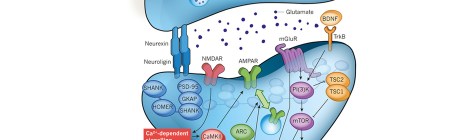
Ever since synaptic gene mutations were discovered in autism, the scientific world has been obsessed [1, 2]. Interestingly, however, these synapse-specific genes make up only a small minority of autism […]
“Synapse” is a ref-flag word nowadays in many sects of autism research. For Dan Geschwind of UCLA, a highly intelligent and very talented molecular biologist, this is definitely the term […]
I have to admit that, like most human beings, I can over-focus at times. On this blog, I’ve gone on and on about the embryonic origins of autism and how […]

Even though, at face value, cancer and autism may seem like worlds apart, if you take a look at their respective genetics you may find more similarities than you bargained […]
“An extremely large number of genes have been associated with autism. The functions of these genes span numerous domains and prove challenging in the search for commonalities underlying the conditions. […]
 Science Over a Cuppa
You must be logged in to post a comment.