Brief Update: What’s New in the Field of Autism Genetics?
Unfortunately this week I’m bogged down with a lot of writing (grant, manuscript revision, etc.) and so my post is going to have to be rather short. But I wanted […]
Unfortunately this week I’m bogged down with a lot of writing (grant, manuscript revision, etc.) and so my post is going to have to be rather short. But I wanted […]
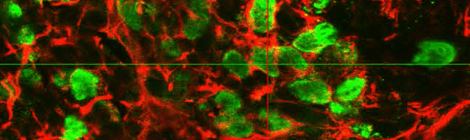
A paper published this month in Stem Cell Reports by Le Belle et al. out of UCLA suggests that maternal inflammation during pregnancy, such as occurs during an acute illness […]
Awhile back, I wrote about how the neurotransmitter, GABA, can behave as an excitatory signal in certain cell types rather than the inhibitory signal with which we’re more familiar. As […]
“Vaccine Encephalopathy”. Despite the medical-sounding terminology, it’s a very poorly defined term and is used to describe developmental regression, seizures, and sometimes coma in an infant or young child, beginning […]

A letter was published this month in Nature Genetics by Gaugier et al. which has received notable attention. While many of us may be familiar with rare variants of genes […]

Sometimes, parents have to fight like tigers to advocate for their kids. I think we’ve all had unfortunate run-ins with healthcare professionals who have the bedside manner of a prickly […]

A few years ago, researchers reported that the Fragile X Mental Retardation (FMRP) pathway helps to regulate expression or activity of 93 genes linked with idiopathic autism [1, 2]. FMRP, […]

From left to right: Ami Klin, Laura Klinger, Francesca Happé, and Joe Piven. My fiancé, Manny Casanova, and I just finished attending this year’s International Meeting for Autism Research (IMFAR) […]
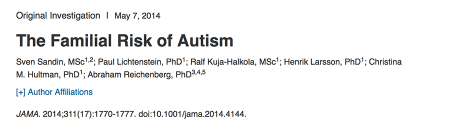
Just this month an article was published in the Journal of the American Medical Association which assessed the familial risk of autism. This was a gigantic population based study on […]

An article was published recently in The New England Journal of Medicine by Eric Courchesne’s group, investigating what is essentially evidence of dysplasia (underdevelopment due to prolonged progenitor proliferation at […]
 Science Over a Cuppa
You must be logged in to post a comment.